From Insights to Action: How Companies Actually Improve Their AI Visibility
The way people search for information is fundamentally changing. Instead of using traditional search engines, users are increasingly asking AI systems directly. Whether it’s product recommendations, provider comparisons, or purchase decisions, the answers are now generated in real time by AI.
For companies, this creates a new challenge: Visibility no longer happens only on Google. It happens inside AI-generated answers.
But this is exactly where a critical problem emerges.
The New Visibility Problem: Insight Without Direction
Many companies have already started analyzing how their brand appears in AI-generated answers:
- Is the brand mentioned at all?
- In what context does it appear?
- What is the sentiment (positive, neutral, negative)?
- Which competitors are being preferred?
These insights are valuable. But they fail to answer the most important question:
What should I actually do to improve this visibility?
This is where traditional analytics falls short.
It provides transparency but not prioritization and it highlights problems but not solutions.
Why AI Visibility Works Differently
To understand why actionability is critical, we need to understand how AI systems select information.
Unlike traditional search engines, AI visibility is not just about rankings. It depends on:
- Trusted sources (authoritative sites, directories)
- Mentions across the open web (forums, reviews, community platforms)
- Consistent brand presence across multiple sources
- Structured, clear website content
This means: Visibility is not created in one place but across an ecosystem of signals.
For companies, this makes things significantly more complex: Optimizing just your own website is no longer enough.
The Missing Piece: Clear, Prioritized Actions
What has been missing so far is the bridge between data and execution:
- Which actions have the biggest impact?
- Where should I invest first?
- Which platforms actually matter for my industry?
- What content is missing?
Without clarity, two problems typically arise:
- Inefficiency: teams work on low-impact initiatives
- Inaction: decisions are delayed due to lack of prioritization
This is where a new approach comes in.
Actions: Turning Analytics into Execution
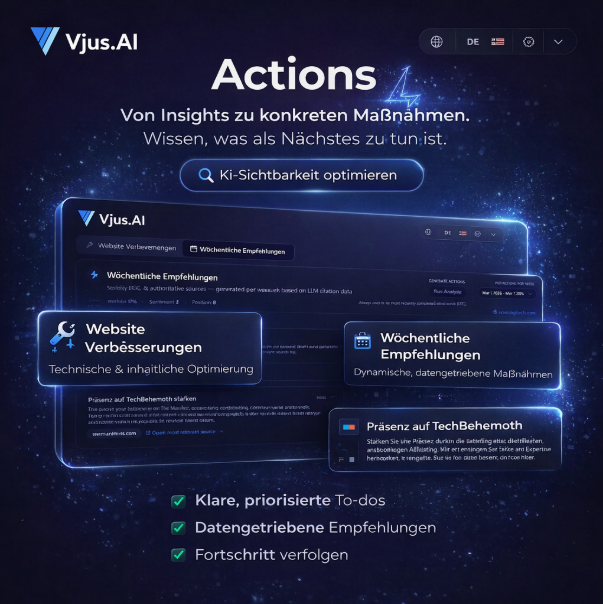
With Actions, Vjus.AI transforms AI analytics into clear, prioritized recommendations.
Instead of just showing how a brand performs, Actions answers the key question: “What should I do next?” The system follows a simple principle: Maximum impact with minimum uncertainty.
Actions are structured, prioritized, and directly actionable based on real LLM data.
The Two Dimensions of Actions
1. Website Improvements: Strengthening Your Foundation
Your website remains a core component of AI visibility.
Actions identifies:
- Missing or unclear content
- Structural issues that make it harder for AI to understand your brand
- Optimization potential in terms of topic coverage and clarity
These improvements are delivered as a continuous, trackable checklist.
Example: Ophthalmologist in Munich
For an ophthalmologist (Augenarzt) in Munich, Actions might recommend:
- Creating dedicated pages for specific treatments (e.g. cataract surgery, glaucoma, LASIK)
- Adding structured FAQs such as “When should I see an ophthalmologist?”
- Improving local signals (clear address, services, specialties)
- Publishing educational content to strengthen topical authority
The goal: Make the website easier for AI systems to interpret, trust, and reference.
2. Weekly Recommendations: Building Visibility Across the Ecosystem
AI visibility is largely shaped outside your own website.
That’s why Actions provides weekly updated recommendations based on real LLM data:
- Where is your brand currently missing?
- Which sources influence AI-generated answers?
- Where are competitors more visible?
These recommendations are divided into two key areas:
UGC (User Generated Content)
- Reviews
- Forums
- Community platforms
Reference Sources
- Directories
- Authoritative sites
- Industry platforms
Example: Ophthalmologist in Munich
For the same ophthalmologist in Munich, Actions could recommend:
UGC:
- Increasing presence on review platforms (e.g. patient reviews)
- Engaging in relevant health forums where eye treatments are discussed
- Encouraging satisfied patients to leave detailed reviews
Reference Sources:
- Ensuring listings in medical directories and local business platforms
- Improving profiles on authoritative healthcare websites
- Filling gaps where competitors are already mentioned but the brand is missing
Why Weekly Dynamics Matter
A key difference from traditional SEO: AI visibility is dynamic. The sources AI systems rely on are constantly changing. New platforms gain relevance, others lose influence. Static strategies are no longer sufficient.
Actions addresses this by:
- Continuously updating recommendations
- Adjusting priorities based on new data
- Identifying emerging opportunities early
The Strategic Advantage: Clarity
The biggest value of Actions is not just the recommendations themselves but the clarity they provide.
Companies get:
- Concrete next steps instead of abstract insights
- Prioritized actions instead of scattered data
- Measurable progress instead of isolated improvements
This reduces complexity while increasing execution speed.
Conclusion: AI Visibility Requires Execution, Not Just Analysis
The shift toward AI-generated answers is fundamentally changing how visibility works.
To succeed, companies need to:
- Understand how they appear in AI systems
- Identify the highest-impact actions
- Execute consistently
The real differentiator lies in step two. Insights show reality. Actions change it.
With this approach, Vjus.AI evolves from a monitoring tool into a platform that actively helps companies improve their AI visibility systematically and at scale.