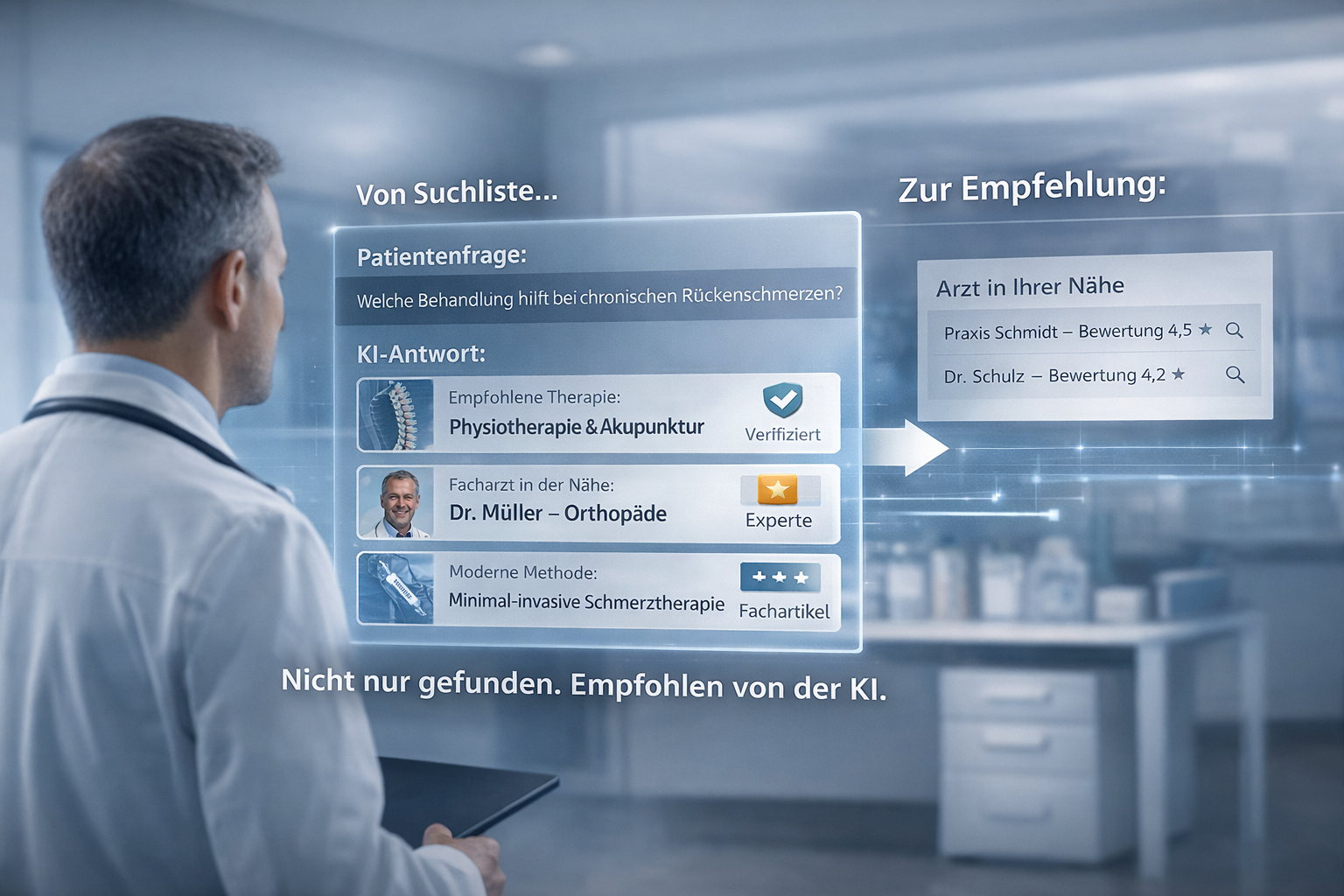
GEO in Practice: How Consultancies, Practices, and Brands Become Visible in AI Systems
The real shift isn’t happening in Google
Many companies are still discussing how SEO is changing. But the more relevant question is already a different one: How does visibility emerge in systems that generate answers instead of listing results? Because that’s where a growing share of attention is moving.
Platforms like ChatGPT, Perplexity AI, or Google Gemini increasingly determine:
→ which providers are mentioned
→ which solutions are considered relevant
→ and which brands are trusted
The key development: Visibility is no longer searched – it is synthesized. And that’s exactly why traditional SEO logic is no longer sufficient.
1. GEO for consultancies and service providers: Trust becomes the entry ticket
Why knowledge-based services benefit the most
Consultancies, agencies, and service providers have a structural advantage: Their product is knowledge. And that is exactly what generative systems rely on.
AI systems tend to prioritize content that:
• demonstrates expertise
• explains relationships
• supports decision-making
• is structured and easy to interpret
An analysis by McKinsey & Company shows that decision processes are increasingly prepared digitally—often long before any direct contact happens. The new dynamic in B2B decision-making
Previously:
→ Research
→ Vendor lists
→ Comparison
Today:
→ A specific question
→ AI delivers structured options
→ Shortlisting happens before the first interaction
This means: A significant part of positioning happens before you ever speak to the client.
What GEO actually means here
For consultancies and service providers, this means: Content must not only inform, it must function as a decision-making foundation.
This includes:
• clear positioning (what do you stand for?)
• coherent argumentation
• understandable models and frameworks
• visible specialization
→ If you are present, you are considered.
→ If you are absent, you don’t exist in the decision process.
Strategic implication
The relevant question is: “Is my expertise recognized as reference-worthy by AI systems?”
2. GEO for practices: From local search to contextual recommendation
Why local visibility is being redefined
Practices have long benefited from local search:
→ “doctor + city”
→ list
→ selection
This model is now being expanded and partly replaced.
Users are increasingly asking questions like:
→ “What helps with chronic back pain?”
→ “When should I see a cardiologist?”
And this is where AI systems step in.
The key shift: Local visibility becomes contextual.
This means:
• it’s no longer just about “being nearby”
• it’s about “being relevant within the answer”
A study by Pew Research Center shows that health-related information is among the most frequent digital search intents—an area heavily influenced by AI-generated answers.
What GEO means for practices
Practices need to understand: Visibility is no longer driven only by directories but by content that provides medical context.
This includes:
• clear explanations of conditions
• defined areas of expertise
• structured, machine-interpretable content
• trust signals (e.g. qualifications, specialization)
→ A practice is no longer just found.
→ It is recommended as a fitting solution.
Strategic implication
The key question becomes: “Do I appear in the answers my future patients see?”
3. GEO for brands: Influence instead of reach
Why brands are affected differently
Brands have an advantage:
→ awareness
→ trust
→ recognition
But that’s also where the risk lies.
Because: AI systems do not automatically prioritize well-known brands.
They prioritize:
• relevance
• context
• reliability within the answer
The new form of competition
Previously:
→ Visibility drove attention
Today:
→ Being part of the answer drives influence
A forecast by Gartner indicates that the traditional search landscape will significantly shift due to generative AI with direct impact on brand perception.
The problem many companies face
Brands measure:
• reach
• impressions
• clicks
What they often don’t see:
→ whether they appear in AI-generated answers
This leads to a paradox: A brand can be highly visible and still absent in the new system.
What GEO means for brands
Companies need to learn to:
• position their content as reference points
• build topical authority
• send consistent signals across sources
This includes:
• clear narratives
• structured content
• depth over volume
→ Brands must not only be present.
→ They must be citable.
Strategic implication
The decisive question is: “Is my brand perceived as a relevant source by AI systems—or just one option among many?”
The underlying pattern
Across all three groups, one principle becomes clear: Visibility is shifting from selection to preselection.
This means:
• decisions are influenced earlier
• perception is formed before interaction
• competition becomes less visible
Conclusion: GEO is not a channel, it’s a new visibility system
Most companies are currently facing the same challenge: They are optimizing for a model that is losing relevance while ignoring a model that is just emerging. The key question is no longer: “Should we do GEO?”
But: “How large is our gap in a system we cannot yet measure?”
→ This is where benchmarking becomes critical
Because: Only those who understand where they stand can become visible. And only those who are visible can become part of the decision.