Claude API made cheaper: cut costs by up to 45 % with prompt caching
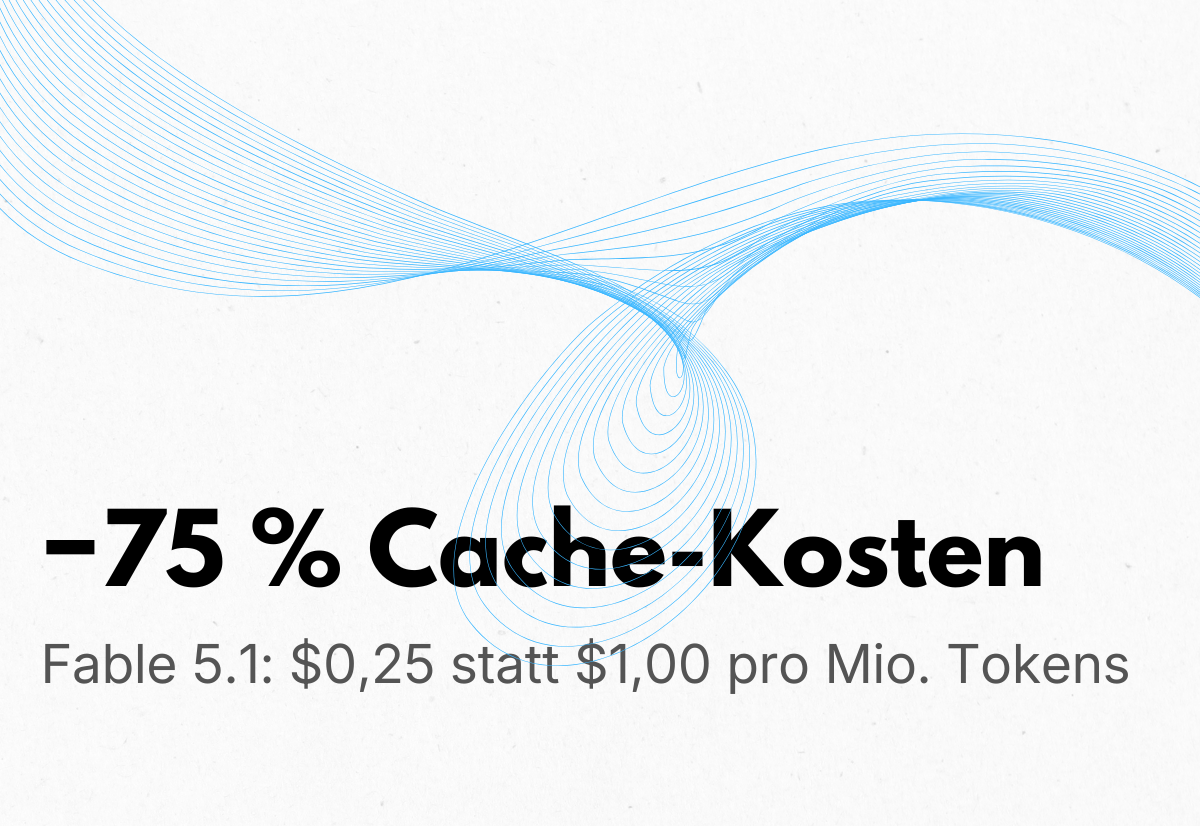
Anthropic has cut cache-read prices by 75 % with Fable 5.1 — from $1.00 to $0.25 per million tokens. Companies using prompt caching correctly can cut their API bill for AI agents and support bots significantly without changing any functionality.
AI agents, support bots and document-analysis tools all consume tokens — and tokens cost money. Anyone using the Claude API in a mid-sized business knows the effect: an agentic workflow that re-submits the same system context across dozens of steps quickly adds up to three-figure monthly bills. With Fable 5.1, released by Anthropic on 1 September 2026 as a GA version, there is now a simple lever to reduce that bill: prompt caching.
What has changed?
Fable 5.1 keeps the same base pricing as Fable 5 ($10 input / $50 output per million tokens). The decisive difference lies in the cache-read price: Anthropic has cut it from $1.00 to $0.25 per million tokens — a reduction of 75 %. That equates to 2.5 % of the standard input rate, a multiplier no other Claude model achieves. [Source: VentureBeat, 3 September 2026]
Model Input ($/M) Cache-Read ($/M) Output ($/M)
Fable 5 $10.00 $ 1.00 $50.00
Fable 5.1 $10.00 $0.25 (−75 %) $50.00
Opus 5 (comparison) $5.00 $0.50 $25.00
For SMEs running Fable 5 agents: the price cut takes effect without migration. Those already using prompt caching save immediately. Those who have not enabled it yet can switch it on now — Anthropic estimates typical workloads become roughly 25 % cheaper, and highly agentic workflows with large repeated contexts up to 45 % cheaper.
When does prompt caching pay off — and when does it not?
Prompt caching stores a context block on Anthropic's servers for five minutes (with automatic renewal on each access). Every API call within that window that reads from the same cached block pays only the cache-read price instead of the full input price. Savings arise wherever a large, stable block is reused at short intervals.
- Support chatbot with an extensive FAQ knowledge base: the system context with product descriptions, price lists and support rules is cached once and reused across every customer conversation — the main cost block is eliminated for each subsequent call.
- AI agent for document analysis: an agent reviewing a 50-page contract in multiple steps (extract clauses → review → summarise) pays for the document content only once as input — all subsequent steps read from cache.
- Ticket routing and classification: when an agentic workflow checks many tickets against the same category catalogue in quick succession, caching pays back after just a few requests.
- Batch processing with a shared system prompt: invoices, e-mails or reports processed within a five-minute window can share the same cached instruction block.
- Not suitable: one-off, infrequent or highly variable requests where the context changes fundamentally each time — no cache hit occurs and the cache-write cost ($1.25/M tokens) is wasted.
How to set up prompt caching: a checklist
Technically, prompt caching is an extension of the existing API call — no new endpoint is required. Teams that have already completed an AI integration into existing software can work through the following checklist directly:
- Set a cache breakpoint: mark the stable context block in the `system` field or `user` blocks with `"cache_control": {"type": "ephemeral"}`. Anthropic caches everything up to the last breakpoint set.
- Respect the minimum size: cached blocks must be at least 512 tokens (Fable models). Shorter blocks are silently ignored — no error is returned, but no caching occurs. Check the `usage` fields in the response to confirm cache hits.
- Stable before variable content: place the system prompt, FAQ data or document content at the very beginning — variable user queries follow. Caching works prefix-based.
- Factor in cache-write cost: the first call that writes the block costs $12.50/M tokens (1.25× the standard input rate). The investment is already recouped on the second access within five minutes: 2 × $10 without caching, $12.50 + $0.25 = $12.75 with caching.
- Monitor usage via the `usage` response: the API returns `cache_creation_input_tokens` and `cache_read_input_tokens` — use these to measure the actual cost advantage.
- GDPR note: prompt caching stores data temporarily on Anthropic's servers. Check whether your system context contains personal data that requires additional documentation in your data processing register.
Verdict: for whom is it worth it — and when is it still too early?
Prompt caching is not a new concept, but the 75 % price cut in Fable 5.1 meaningfully shifts the economics. A concrete recommendation for IT consulting in mid-sized companies:
- Enable now: any company running Claude agents or bots with recurring system context today should switch caching on immediately. The implementation effort is low (a few lines of code) and savings begin right away.
- After a usage analysis first: if you do not yet know your cache-hit ratio, it is worth logging the `usage` fields for two weeks before restructuring your architecture around caching.
- Not yet useful: single requests without a batch character, or applications where the context changes completely with each request — caching makes the request more expensive ($12.50 vs. $10/M tokens) without ever hitting the cache.
- Not a substitute for a model downgrade: if budget constraints prompt a move to a cheaper Claude model, evaluate that separately. Caching optimises costs at your chosen model — it does not affect quality or latency.