Why Good SEO Is No Longer Enough: Third-Party Signals for Your AI Visibility
AI systems like ChatGPT and Gemini follow their own rules: 85 percent of brand mentions in AI responses come from third-party sites, and domain authority explains almost nothing. What mid-sized companies should do now.
When someone asks ChatGPT or Gemini for a software agency in Munich, they receive an answer — but not necessarily from companies that rank on page one of Google. AI systems follow their own rules for source selection, and these rules have little to do with classical SEO. For mid-sized companies that want to remain visible in digital channels, this creates a growing gap.
The use of AI search is growing steadily — an increasing share of information queries now runs through ChatGPT, Gemini, or Perplexity rather than through traditional search engines. Companies absent from these AI responses lose visibility — regardless of their position in Google results. The problem: many companies continue to optimize only for Google and only notice the gap when competitors are already present in AI responses.
How AI Systems Select Sources
An analysis by The Digital Bloom measured which factors actually predict ChatGPT recommendations: Classic SEO metrics such as search engine ranking or backlink count together explain less than 10 percent of the variance. Domain authority — a central metric in traditional SEO — correlates at only 0.18 with AI citations, making it nearly irrelevant. What correlates strongly instead: brand mentions on third-party sites that the company does not control itself.
Third-Party Signals Compared: What Counts — and What Doesn't
Signal Correlation / Explanatory PowerAssessment
Brand mentions on third-party sites r = 0.66 Strongest measurable signal
Backlink quantity r = 0.20 Weak but present
Domain authority r = 0.18 Nearly irrelevant for AI
Google ranking position 5.8% explained variance Very low predictive power
JSON-LD schema markup no significant effect No measurable AI uplift
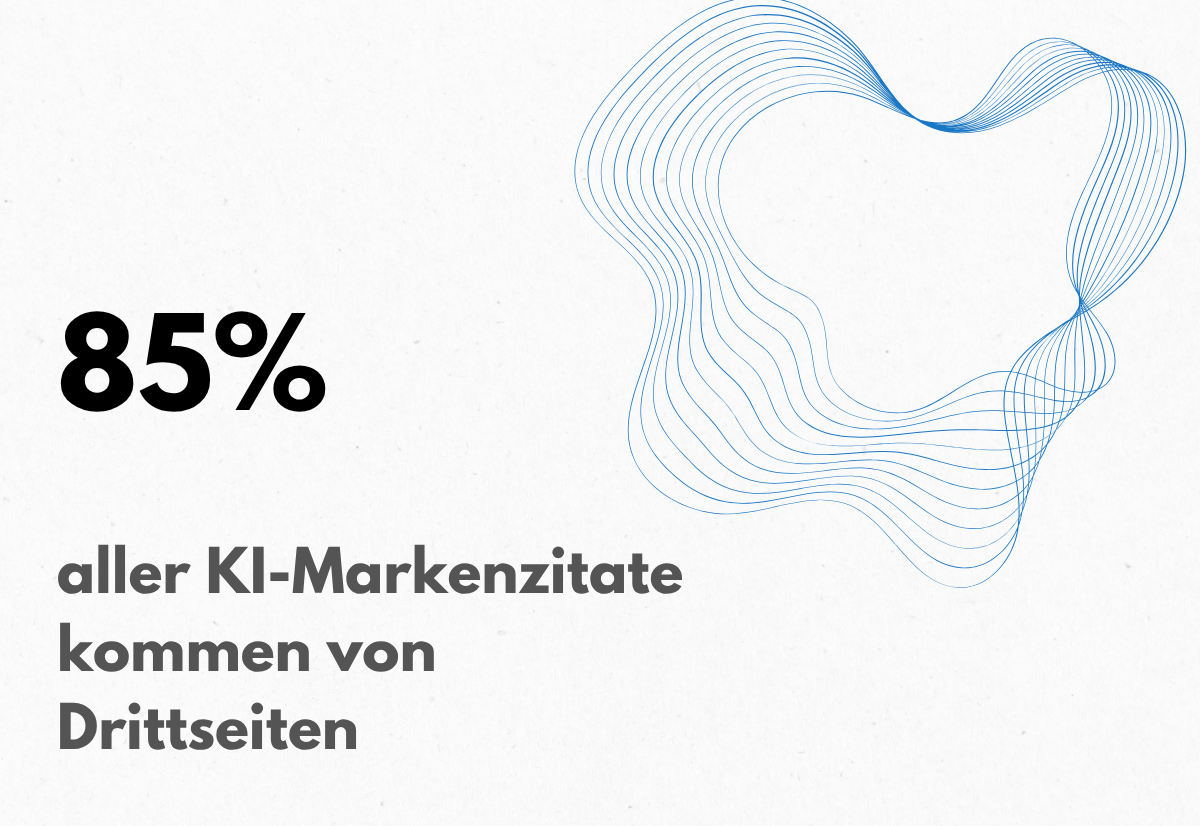
Current analysis by Lumen GEO shows: 85 percent of all brand mentions in AI responses come from third-party sources — not from the company's own website. Brand mentions correlate at r = 0.66, three times stronger than backlinks. Reddit alone accounts for 22.9 percent of all AI citations — a channel that often plays no role in traditional SEO strategies.
What Concretely Works: Five Levers for More AI Visibility
- Entries in professional and industry directories (chamber of commerce lists, thematic aggregators, review portals like Trustpilot or Kununu): mentions act as signals even without a direct backlink.
- Guest articles and quotes in trade press or industry blogs: AI systems read these pages and categorize the company thematically — it works best when the brand name and service area appear in the same sentence.
- Active presence in professional forums and communities: comments in LinkedIn groups, answers on industry forums, and mentions in discussions increase mention density on third-party sites.
- Consistent company presentation across all sources: spelling of the company name, short description, and service areas must be uniform — AI systems match entities across channels.
- Structured internal linking on the company website: contextual links to service pages help AI systems understand the service portfolio — a mechanism that AI integration and automation consistently applies.
What This Means for Your Business in Practice
SEO remains the foundation for Google visibility. But AI visibility follows its own rules that cannot be fully controlled through technical SEO. Mid-sized companies with little presence on external platforms have a growing gap. The more queries run through ChatGPT or Gemini, the greater the impact on inquiries and perception.